
Very quiet. The bodegas sealed up, and even some the bakeries were closed. There are some unusual homes here with large vines tied to them with long ropes. We never discovered their purpose, but my guess is if we came back in three years, the home will be riotous with ivy and blossoms. Now, at dawntime, they made the houses look like bound stacks of newspapers.
Extra, extra! I had some meat left over from The New Ship and was hyper-vigilant for strays. Fed a friendly mutt and a suspicious cat. The latter left sweet little paw prints in the dew of the park. Warm paper cups in hand, we summoned a cab by drawing signals in our latte foam.
Rode in relative speed and quiet to the vagsal. It's an old, pleasant building with a nice view of the sea and the larger newer buildings of Batumi in the distance. I liked thinking about generations of families being as familiar with it as Alabama families are with the Disney World parking lot.

We didn't think getting a ticket was going to be difficult at that hour, and it wasn't. But it looked like we got the last ones, because the seats were where the train employees usually sit. We had gotten the equivalent of the "jump seats." Packed train. We reckoned vacation was over for everyone else and it was back to work. We only had two days left ourselves.
There was a giant chunk of compressed folded paper on my arm rest, so I handed it to Sara when she got up to find the restroom. She hucked it in the huckerbin. We didn't take for granted that this train had a restroom. After the Midnight Train from Ganja, we never will again. With a double-decker car of tired, happy families, we moved closer to Tbilisi.
One thing we both noticed on the trip, intensified in the close quarters of the train, was men's reaction to children. Throughout Georgia, otherwise hard-faced men melted at the sight of a child. We saw them kneeling to address kids and do any small thing in their power to assist them, and they always smiled and spoke gently.
Surviving years of occupation and the threat of war will do that, I think. Every child seems like a miracle and proof of survival and advancement. The train was swarming with kids and the beaming faces of their parents and the train staff. One little girl had apparently been on this route a number of times. She showed everyone how to operate a tricky restroom door. It slides, you see. Pushing it does nothing.

I had hoped to recapture that writing zone on this ride back, but these jump seats didn't have tables. So, I finished Bread and Ashes instead. A really marvelous book, rambling and sentimental. Thoughtful, literate, observational, funny -- the perfect book to read in that part of the world. Out of the corner of my reading, I saw The Bathroom Door Girl hand one of the train workers a giant stack of papers that had been next to her seat.
They were, Sara noticed, almost exactly the same kind of thing I had asked her to throw in the trash. It was probably receipts and tickets and... valuable records of this trip. And we had hucked half of them in the huckerbin. We hoped they had a digital backup copy.
We roared past a city called Kutaisi. It had been on my list as a possible day trip, chiefly on account of a super-nutty fountain with brass animals crawling all over it, but.. you can't do everything. We can't be accused of not trying to, though. Next time, fountain. There's always something.
I have a list for a trip I call the "Lips and Assholes Tour" where I go back chiefly to see all the little places and things I was close to but didn't quite make it to on previous trips. The trip is named after what someone once told me was the recipe for lunch meat bologna. Kutaisi Fountain, you made the list!

Train drifted along pleasantly. There was no meal service, but we had loaded up with water and nuts and snacks, and the first four of the six hours was all comfortable reading and idle snacking. At some point, a man sitting across from us asked if he could plug his phone into an outlet behind us. It involved putting his cell phone on my headrest. It was, of course, no problem at all, and I moved aside to let him plug it in.
He asked where we were from, and when I said "California in the United States," he said "Ah! Enemy territory!" And though he didn't say it in a mean way, it always gives you pause when someone "pretends" they don't like you for a moment. There's a lot of legitimate tension in the world, because it's in the interest of the oligarchs to keep us afraid of one another.
No industry in the world exists in the form in which it exists because it must exist that way. The forms industries take is based on who is making money from them and the power they wield to keep them as they are. We don't have enemies, but it's hard to sell weapons if you don't. We don't need oil, but it's hard for the people who make money from it to stop. We don't need high fructose corn syrup, but the corn people fight to keep sugar expensive.
Everything is advertising. Everything is narrative. Nothing is real but love (and even that is often slave to narrative). Nothing is necessary but communal feeling. And that single, crucial necessity is under constant assault and manipulation. For profit.
I am a great fan of this bit of Rousseau's:
"The first man who, having enclosed a piece of ground, bethought himself of saying This is mine, and found people simple enough to believe him, was the real founder of civil society. From how many crimes, wars and murders, from how many horrors and misfortunes might not any one have saved mankind, by pulling up the stakes, or filling up the ditch, and crying to his fellows, "Beware of listening to this impostor; you are undone if you once forget that the fruits of the earth belong to us all, and the earth itself to nobody."

His name was Muhammad, and he was from Iran. He was very interested in how people from the US view Iranians. I told him people who read think of Iran as a beautiful place with good people who are struggling under a restrictive government, but that people who watch TV think Iranians are angry, religious people who wake up and go to sleep saying "Death to America."
I was taking a small risk saying these things, I guess, but from his presentation and from our surroundings, it felt like saying it that way was fair and mostly true. It also just, kind of.. came out that way.
He looked pained at the second part. Like, that is what he thought most Americans think. I asked him the same question, of course. How is the US viewed in Iran? He said they think we are either ignorant or full of hate.
And then we had the scripted conversation I have overheard and taken part in a hundred times on my travels:
It's not the people, of course. It's the governments.
Yes, the governments! They only care about money.
Every time I meet a person from (insert country), they are kind and good.
But the governments make money from keeping us in fear.
It is how they control us.
It is good to meet you.
We are all brothers.
Can I have my phone back?
Of course.
When we arrived in Tbilisi, Muhammad helped us orient ourselves "This is it. I am not joking. This is Tbilisi." We actually weren't sure, so it was very helpful. We said goodbye, and he came back to say he would like to help us find a hotel if we needed one or anything we needed.
He was very nice, and it was hard to tell him we had arranged lodging long ago, but people need something to make themselves feel helpful, so I asked him if he knew where the train station restaurant was, and he said "YES!" and pointed us to where we had gotten hard boiled eggs a few days ago. We smiled and thanked him, and this was the perfect way for everyone to feel like the other was kind and that it was only the accident of our birthplaces that would suggest any enmity between us.

We WERE legitimately hungry, though, (but not for eggs), so after a quick taxi from the vagsul, we got dumped off back in familiar old Rustaveli Square and hauled our bags into a funny old "fancy" Khinkali house. It had these hilarious remote controls on the table so you could summon the server. We were like rats pushing a lever to trigger more pellets out of the feed-chute.
Had the usual struggles with a cab. A week earlier, Noble Joe's obsidian beard had parted in an enormous smile to laugh and say we needed a special Taxi app on our phones in order to to have any experience but torment. But I had not done it.
And so we were treated in the usual way, like a couple of anteaters who had climbed in the backseat of a van trying to catch a ride back to the zoo. Where the ants are. The driver we found called over a couple more drivers to crowd-source the best way to our destination. Addresses, screenshots of the apartment, maps, a note from the US embassy, a compass, Sauron's palantir, and a trail of breadcrumbs were all useless. It was either, they know it or they don't. And they never knew it.
Take me over there.
Where?
Right there, we're all looking at it. That corner right there.
I've never been there.
It's ok. It's just straight ahead.
I'm going to have to consult with my friends.
It's on the cover of the guide book. It's the most famous place in Tbilisi.
I'll be right back. I need a coffee and four other drivers.
We are all brothers.
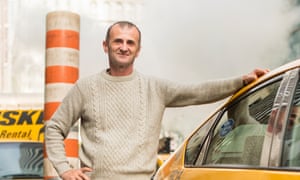
His buddies sat in their own cabs and ate bread wrapped in yellow paper and chewed and sprayed and nodded and eventually one did the hand dance that mapped our route out in the air. The driver got it, and we were off down a narrow alley paved with barnacles.
The sides of the car almost scraped the walls on either side, but a guy in a fishing hat found room to reach through the window and hand our driver a Dixie cup full of clear liquid. I was sure it was chacha.
He paused to drink it, which gave Fishing Hat time to reach through the back window and offer a cup to Sara. She tried to turn it down, but he was willing to have his arm torn off before allowing her to refuse his hospitality.
She accepted it, took a cautious sip, and spat it out. So, you know, I had to try it.
By this time, we had taken off again over the mussel-and-oyster-shell-pavement and the cab was jouncing like an Azerbaijani mashrutka on the road to Yevlak.
The driver hadn't offered us the trunk for our suitcases, so they were piled in the back with us, and I was in the absurd situation of trying not to spill the gift-liquid on my camera or over our clothes.
It eventually smoothed out, and I drank. It was mineral water with an exceptionally high level of carbonation. I understood why she had spit it out, there was an unexpectedly harsh bite. But it wasn't chacha, which meant the driver wasn't drunk...probably.
Having survived all of this put me in a suddenly light mood, and when the radio started playing "Nothin's Gonna Change My Love For You" I started singing along at the top of my voice.
The driver turned it up to an exceptional volume, and I wasn't sure if it was because he knew I was enjoying it or if he was trying to drown me out.
It was still, at this point, unclear if he was taking us to the right place.

No comments:
Post a Comment